
A Hemispheric Strategy Driven More by Politics Than Security
The Trump administration released the 2025 national security strategy with language that claims to reorient American foreign policy around threats inside the Western Hemisphere rather than the major powers that traditionally shape global security planning. The document presents the Western Hemisphere as the centerpiece of national security even though it contains no military peer capable of challenging the United States in any serious way. The strategy elevates migration, narcotics, and regional instability above the capabilities of nations like China and Russia even though the Pentagon continues preparing primarily for conflict with those two states. This tension reveals a strategic framework shaped far more by domestic political messaging than the actual conditions that define modern power competition across multiple regions. The result is a policy statement that places political imperatives at the center of national security planning, creating confusion about the genuine priorities of American strategy.
Marco Rubio’s Expansive Influence Over Strategic Messaging
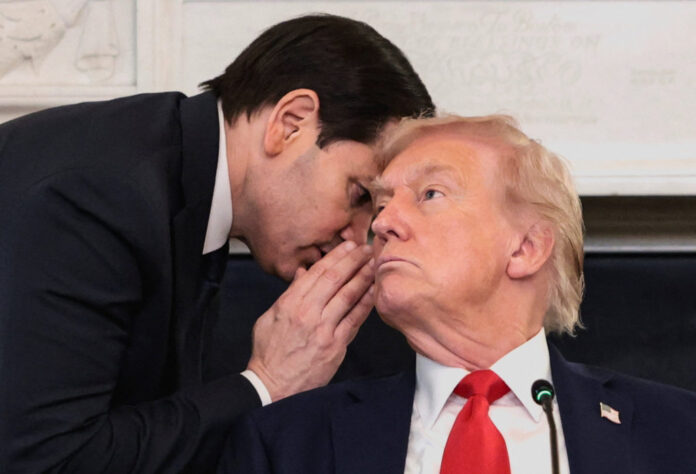
Marco Rubio holds an unusually broad set of responsibilities within the administration, enabling him to shape the strategic message surrounding the Western Hemisphere with significant authority. Juan David Rojas reported that Rubio is “simultaneously serving as secretary of state, national-security adviser, and US archivist,” revealing a consolidation of influence rarely seen in modern administrations. Rubio advances a narrative that portrays Venezuela as a platform for foreign adversaries, claiming that “Iran, its IRGC and even Hezbollah, has a presence in South America,” and also asserting that “where they have planted their flag in our hemisphere is on Venezuelan territory.” Rubio further stated that “the fact that Maduro feels threatened by the presence of US assets in the region and counter drug mission, proves he is into the drug business,” a claim that strengthens a sense of threat without presenting verifiable military evidence. These statements help build support for policies that elevate regional adversaries far beyond their actual capabilities.
Threat Narratives Amplified Beyond Strategic Reality
Analysts observing the push for confrontation with Venezuela describe a process driven more by domestic politics than strategic necessity. David Dayen argued that policymakers acted “for Marco Rubio’s right-wing South Florida exile friends,” indicating that national security was shaped by a narrow political constituency rather than the broader American interest. Dayen described operations that included “vaporizing alleged drug boats through summary executions,” which raises serious questions about proportionality and operational oversight. He further explained that Rubio sold the effort by connecting confrontation to “the war on drugs,” a narrative that appeals strongly to certain political audiences. Dayen also noted that “almost no fentanyl is produced in Venezuela,” which contradicts the central justification offered for potential escalation.
Consequences of Regime Change Without Strategic Foundation
Advocates of regime change in Venezuela underestimate the likelihood that intervention would create prolonged instability across the region. Juan David Rojas warned that “regime change via foreign military intervention could trigger complete state collapse,” which would generate far-reaching security consequences for neighboring states and the United States. Rojas also observed that “quagmires in Latin America are no more pleasant than those in Mesopotamia,” reminding readers that prolonged conflict can drain resources and reshape commitments for decades. Rubio signaled support for escalation when he circulated an image of Muammar Gaddafi, implying that Maduro “would meet the same fate,” a gesture that intensifies expectations for confrontation.
Strategic Mismatch Between Hemisphere Priorities and Military Investments
The national security strategy insists that the Western Hemisphere represents the primary focus of American national security, yet the nation’s military programs remain aimed at adversaries possessing advanced capabilities. Systems such as the B-21 bomber, the Columbia-class submarine, next-generation air dominance fighters, and hypersonic weapons target threats posed by China and Russia, not by Venezuela or Cuba. Washington invests heavily in these systems because Beijing and Moscow continue expanding military capabilities that challenge American power across multiple domains. The hemispheric focus within the strategy fails to align with this reality and promotes priorities detached from procurement and planning efforts within the Department of Defense. This disconnect produces a strategic environment marked by uncertainty about Washington’s true objectives.
Political Incentives Replace Strategic Logic
Political incentives shape the 2025 national security strategy more strongly than traditional strategic considerations, especially as electoral concerns drive the themes embedded within the document. David Dayen captured this dynamic when he observed that the policy direction sought “to flatter a few power-mad expats with little concern for American interests,” indicating that certain political groups gained disproportionate influence. His account shows how narrow domestic interests can reshape foreign policy in ways that weaken long-term planning. This pattern complicates relationships with allies who expect clear strategic priorities and reliable commitments from Washington. Decisions shaped by political advantage rather than structural realities weaken the coherence required for managing major-power competition.
A Strategy Lacking Alignment With Global Realities
The strategy describes Venezuela and Cuba as central challenges even though neither state possesses the military capabilities required to justify major American mobilization. China and Russia remain the only actors capable of contesting American military power across nuclear, naval, cyber, and aerospace domains. Rubio’s repeated claims regarding Iranian and Hezbollah activities in Venezuela strengthen the hemispheric narrative, yet the absence of corresponding military capability reveals an exaggerated portrayal of threat conditions. The document therefore misreads the distribution of power shaping global affairs during a period of intensifying competition. This misreading creates a strategic framework that cannot guide policymakers effectively.
National Security Shaped More by Rhetoric Than Assessment
The national security strategy presents a framework that resembles a domestic political document more than a blueprint for confronting twenty-first-century challenges. The structure amplifies themes related to migration and narcotics that resonate strongly with political constituencies in South Florida, which contributes to the document’s hemispheric focus. Rubio’s claims about Iranian and Hezbollah involvement reinforce that narrative even though these assertions lack the military significance required for strategic prioritization. The resulting framework weakens coherence and introduces uncertainty into broader American foreign policy. This outcome complicates the nation’s ability to manage challenges arising from great-power competition.
A Strategic Document Detached From Modern Power Competition
The administration’s hemispheric emphasis arises during a period when global competition with China and Russia expands across multiple domains and regions. The strategy’s language mirrors domestic political narratives rather than the military assessments produced by institutions tasked with protecting American global interests. The combination of hemispheric rhetoric and procurement focused on major adversaries reveals a strategic imbalance that cannot support consistent long-term planning. This result produces a national security strategy detached from the demands of modern power politics.
The history of national security strategy shows repeated moments when political priorities shaped the document more strongly than measured strategic assessment, particularly after major domestic shifts in public opinion. The early post-September 11 era demonstrated this pattern when the strategy elevated expansive counterterrorism goals that far exceeded the capabilities of the adversaries involved, revealing how domestic pressure can guide policy framing. Subsequent administrations repeated similar habits as political narratives about democracy promotion, great-power rivalry, and border security shaped strategic language more directly than the distribution of military threats across the international system. Each cycle revealed that national security strategy can transform into a political instrument when leaders rely on it to validate messages that resonate more with voters than with strategic planners. This long record makes the current strategy part of a broader pattern in which political forces guide national priorities more strongly than sober analysis of global power.
Major U.S. Weapons Programs Built for China and Russia
The United States continues to invest in advanced weapons systems created for high-intensity conflict with China and Russia, not the far weaker militaries inside the Western Hemisphere. These programs reveal a strategic posture centered on peer competition even as the 2025 national security strategy shifts its public narrative toward regional threats that cannot challenge these platforms.
Programs Focused on China and Russia:
- B-21 Raider Stealth Bomber
- B-52J Modernization Program
- Columbia-Class Ballistic Missile Submarines
- Virginia-Class Attack Submarines (Block V)
- Sentinel ICBM Program (Ground Based Strategic Deterrent)
- Long-Range Hypersonic Weapon (LRHW)
- Conventional Prompt Strike (CPS)
- Air-Launched Rapid Response Weapon (ARRW)
- Next Generation Air Dominance (NGAD) Fighter
- F-35 Block 4 Upgrade Program
- Aegis Ballistic Missile Defense System
- SM-6 and SM-3 Missile Systems
- THAAD Missile Defense System
- Space-Based Missile Tracking Architecture
- P-8 Poseidon Maritime Patrol Aircraft
- MQ-25 Carrier-Based Refueling Drone
- Expanded Cyber Command Offensive Capabilities
- Nuclear Command, Control, and Communications Modernization (NC3)
