Saudi Arabia Draws a Public Line in Yemen
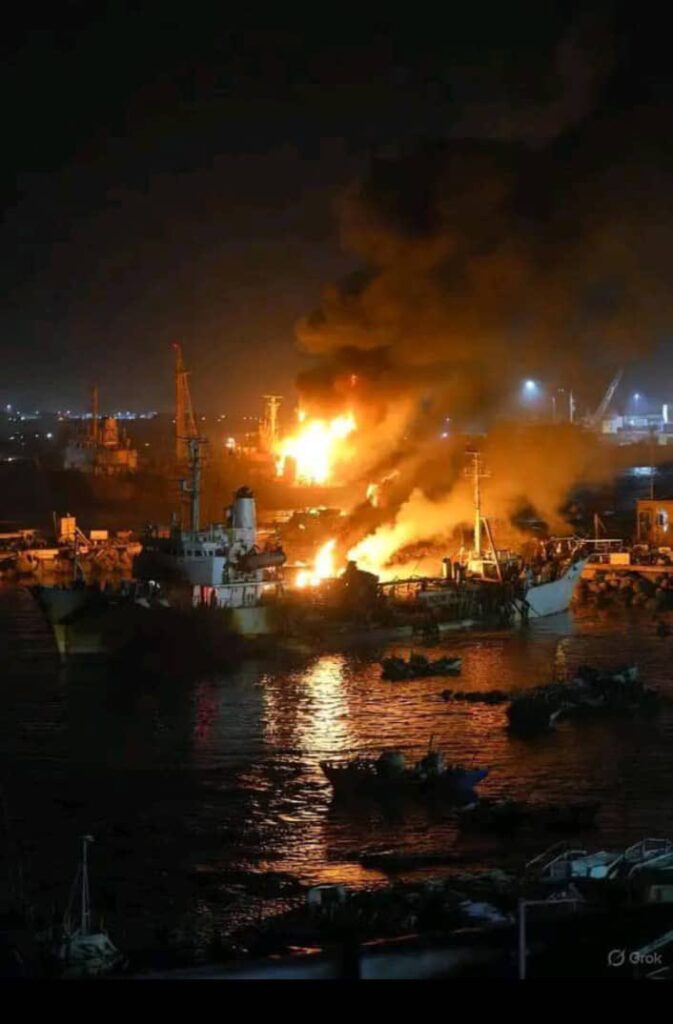
Saudi Arabia launched airstrikes on Yemen’s Mukalla port as a public signal that internal coalition tensions had reached an openly confrontational phase. The strike followed Saudi claims that foreign vessels delivered weapons intended for the Southern Transitional Council, a separatist force backed by the United Arab Emirates. Saudi officials framed the operation as a defensive action directly tied to border security and regional stability concerns. A statement carried by the Saudi Press Agency declared, “Considering that the aforementioned weapons constitute an imminent threat, and an escalation that threatens peace and stability, the Coalition Air Force has conducted this morning a limited airstrike.” That language reflected a calculated effort by Riyadh to justify military action through security doctrine rather than coalition politics.
Mukalla and the Alleged Weapons Shipment
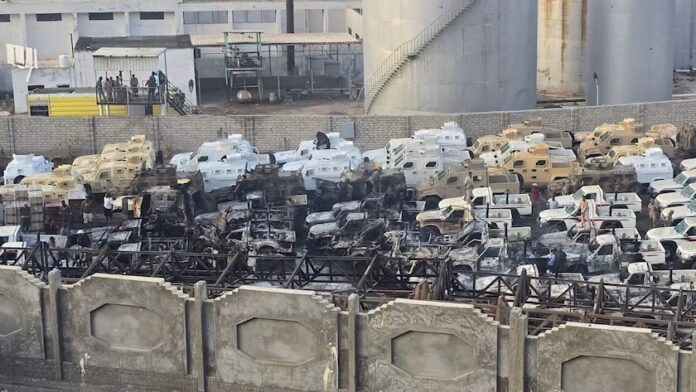
Saudi military officials described the Mukalla operation as a response to covert maritime activity linked to unauthorized arms transfers. Coalition spokesman Brigadier General Turki al Malki detailed the allegations involving vessels arriving from the Emirati port of Fujairah. He stated, “The crews of the two ships disabled the vessels’ tracking systems and unloaded a large quantity of weapons and combat vehicles to support the forces of the Southern Transitional Council.” This account shifted attention away from local fighters and placed responsibility on external logistics networks. Reuters reinforced this focus on maritime activity when it reported, “Two sources told the Reuters news agency that the strike specifically targeted the dock where the cargo had been unloaded.”
National Security Declared a Red Line
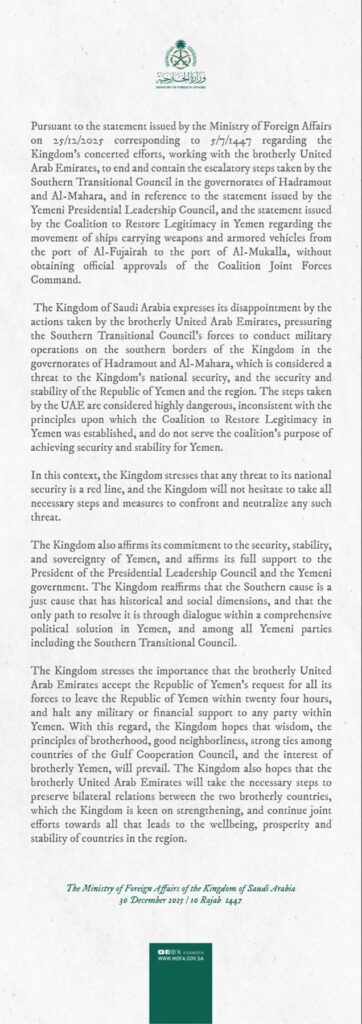
Saudi Arabia responded to the Mukalla incident with unusually direct language aimed at a Gulf partner. The Saudi Ministry of Foreign Affairs released a formal statement expressing dissatisfaction with Emirati actions inside Yemeni territory. The statement warned, “Any threat to its national security is a red line, and the Kingdom will not hesitate to take all necessary steps and measures to confront and neutralize any such threat.” Saudi officials framed the alleged Emirati conduct as incompatible with the coalition’s original mandate. The ministry added that “the steps taken by the UAE are considered highly dangerous, inconsistent with the principles upon which the Coalition to Restore Legitimacy in Yemen was established.”
The UAE and the Southern Transitional Council
The Southern Transitional Council occupies a central role in the growing Saudi Emirati dispute over Yemen’s future. The council seeks autonomy or independence for southern Yemen and receives political and military backing from Abu Dhabi. Sultan Barakat, Professor of Public Policy at Hamad Bin Khalifa University, described this evolving pattern when he said, “Little by little, the UAE started the habit of undertaking foreign policy and independent decisions in Yemen without going back to Saudi Arabia.” His assessment reflected Saudi concerns that Emirati support for separatist forces undermines Yemeni territorial unity. Those concerns have increasingly shaped Riyadh’s posture toward its former coalition partner.
Hadramout as a Strategic Flashpoint
Hadramout carries strategic significance for Saudi Arabia that extends beyond Yemen’s internal divisions. The governorate borders Saudi territory and holds geographic value that Riyadh connects directly to national security calculations. Brigadier General Turki al Malki explained the military rationale behind the strike when he said, “This operation aims to ensure the success of the coalition’s efforts to restore security and stability and to prevent the expansion of the conflict.” Saudi officials have portrayed separatist advances in the east as a direct challenge to regional order. That portrayal places UAE backed forces on a collision path with Saudi security priorities.
Yemen’s Presidential Council Turns on Abu Dhabi
The fallout from the Mukalla strike quickly reached Yemen’s own political leadership. President Rashad al Alimi of the Presidential Leadership Council announced sweeping measures directed at the United Arab Emirates. He described the arms shipment as “an escalatory step against the security and stability of Hadramout and Mahra.” Al Alimi also stated, “The UAE’s role has become directed against Yemenis and openly supports rebellion and internal strife.” Those remarks accompanied decisions to cancel defense arrangements and demand the withdrawal of Emirati forces from Yemen.
A Coalition Fractured in Plain View
The confrontation revealed a coalition divided by competing regional agendas rather than shared objectives. Saudi Arabia continues to present itself as a force seeking a unified Yemeni state free from Iranian backed Houthi control. The United Arab Emirates has pursued influence through aligned separatist movements that secure ports and territory across southern Yemen. Mohammed al Basha, founder of the Basha Report, captured the direction of events when he said, “I expect a calibrated escalation from both sides.” His assessment reflected a reality where cooperation has given way to managed confrontation played out in public view.
Exposing the Rift Behind the Yemen War
The Mukalla strike exposed a deeper struggle over control, influence, and direction inside Yemen’s fractured political order. Saudi Arabia framed its actions through national security language that emphasized borders, unity, and centralized authority. The United Arab Emirates appeared tied to a parallel project that relied on separatist leverage and external supply networks. Public statements from Riyadh and Yemen’s leadership removed ambiguity about responsibility and intent. The episode revealed a coalition that exists more on paper than in practice, with Yemen bearing the consequences of competing Gulf ambitions.