Major Rebel Factions in Syria’s December 2024 Conflict
The ongoing conflict in Syria has fostered a complex web of rebel groups with shifting alliances, ideologies, and objectives. Since the early days of the Syrian revolution, numerous factions have risen and fallen, with some eliminated entirely and others merging to form new entities. These dynamics reflect the fluidity of the battlefield, where survival often depends on adaptability and external support. While many smaller groups remain active across the country, the list below highlights the major players currently shaping events in Syria as of December 2024. Each of these groups plays a distinct role in the conflict, influenced by their leadership, foreign alliances, and operational goals.
Hayat Tahrir al-Sham (HTS)
Leadership: HTS is led by Abu Mohammad al-Jolani, who transitioned the group from an al-Qaeda affiliate to a locally focused faction.
Connections to Washington: Leaked cables indicate U.S. intelligence acknowledged HTS’s predecessor, Jabhat al-Nusra, as an operational ally against Assad during the early civil war.
Operational Focus: HTS emphasizes Islamist governance and military control, prioritizing dominance over territories such as Aleppo, Hama, and Damascus.
2024 Battle Involvement: HTS spearheaded the December 2024 offensive, executing strategic assaults that led to the collapse of Assad’s government and the seizure of Damascus.
Brief History: Founded in 2012 as Jabhat al-Nusra, HTS gained prominence with Gulf-backed funding and Turkish logistical support. After severing public ties with al-Qaeda in 2016, the group sought to establish a governance framework while maintaining military strength in rebel-held territories.
Syrian National Army (SNA)
Leadership: The SNA functions under direct oversight from Turkish military officials, aligning its leadership with Ankara’s strategic priorities in Syria.
Connections to Washington: The SNA adheres to Turkey’s demand, which are highly approved by Washington.
Operational Focus: The SNA operates to secure Turkish border regions, counter Kurdish groups, and stabilize northern Syria in alignment with Turkish interests.
2024 Battle Involvement: The SNA contributed to the broader anti-Assad campaign, focusing on operations near the Turkish border and assisting HTS offensives.
Brief History: Established in 2017, the SNA merged several Turkish-backed factions, inheriting weapons and funding from Turkey to counter Assad and Kurdish groups. Its operations expanded from securing border regions to supporting wider offensives in collaboration with other rebel forces.
Syrian Democratic Forces (SDF)
Leadership: Mazloum Abdi, a Kurdish commander, leads the SDF with a focus on autonomy for Kurdish-majority areas in northeastern Syria.
Connections to Washington: The SDF maintains strong ties with Washington, receiving substantial support in logistics, training, and airstrikes during the anti-ISIS campaign.
Operational Focus: The SDF prioritizes Kurdish self-governance and regional stability while countering ISIS and negotiating with regional powers for autonomy.
2024 Battle Involvement: The SDF remained neutral during the HTS-led offensive, concentrating on consolidating power in northeastern Syria and protecting Kurdish areas. On December 9, 2024 heavy fighting has erupted in Manbij, with Turkish-backed opposition forces launching an offensive against SDF-controlled territories, leading to significant casualties on both sides, as reported by the Syrian Observatory for Human Rights.
Brief History: Created in 2015 as a coalition of Kurdish, Arab, and Assyrian forces, the SDF emerged as a reliable partner for the U.S. in combating ISIS. Its initial focus on liberating ISIS-held territories transitioned to governance and advocacy for Kurdish autonomy in post-ISIS Syria.
Southern Operations Room (SOR)
Leadership: SOR is led by a coalition of Sunni and Druze commanders, reflecting the diverse demographics of Daraa and Quneitra provinces.
Connections to Washington: The SOR received logistical aid through Jordan as part of U.S. initiatives to stabilize southern Syria during earlier conflict stages.
Operational Focus: SOR emphasizes protecting minority communities, maintaining stability, and securing borders near Israel, often avoiding broader rebel group objectives.
2024 Battle Involvement: SOR flanked Assad’s forces from the south, supporting the advance toward Damascus without directly engaging in HTS-led operations.
Brief History: Formed in 2021, SOR unified factions in southern Syria, benefiting from Jordanian funding and indirect Israeli humanitarian aid. It prioritized regional stability, focusing on minority protection and avoiding clashes with Kurdish or Islamist groups.
Free Syrian Army (FSA)
Leadership: The FSA’s leadership consists of defected Syrian military officers advocating for a secular and nationalist opposition to Assad’s regime.
Connections to Washington: The FSA maintained early ties with the CIA through the “Timber Sycamore” program, securing weapons, training, and funding.
Operational Focus: Initially targeting Assad’s government, the FSA later shifted its focus to countering ISIS and stabilizing U.S.-influenced zones in Syria.
2024 Battle Involvement: The FSA played a significant role in the December offensive, advancing from the southern desert to support the seizure of Damascus.
Brief History: Founded in 2011 by defected Syrian soldiers, the FSA was the first organized opposition to Assad’s regime. Supported by Western and Gulf states, it received resources to challenge Assad, although internal divisions and shifting priorities eventually diminished its influence.
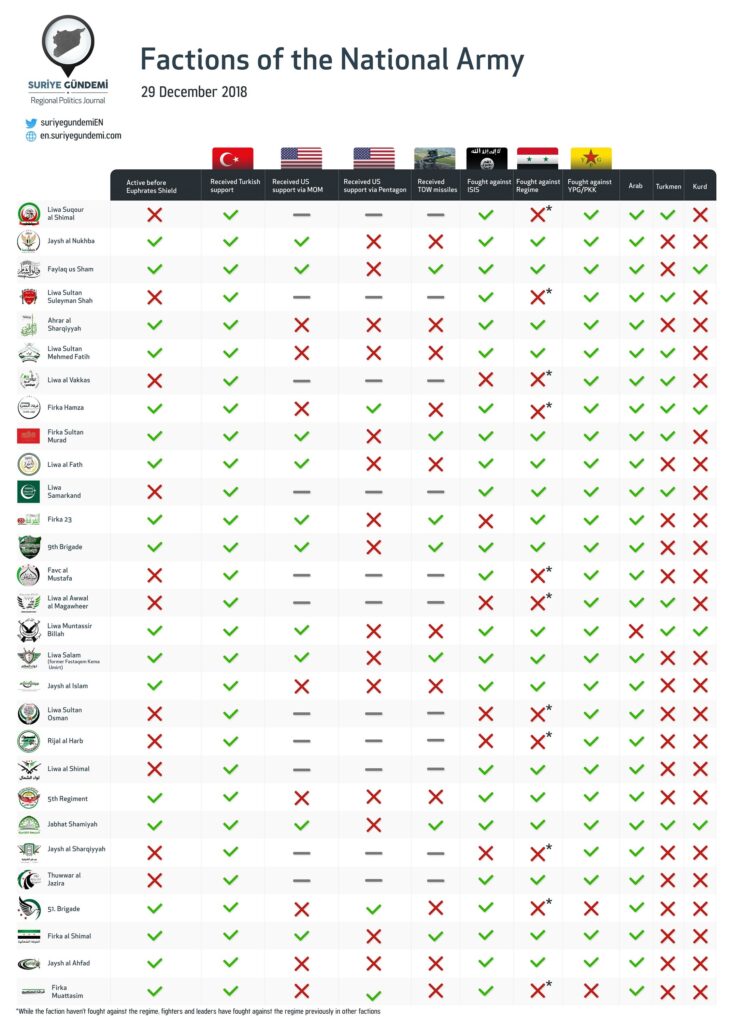
The Fragmented Syrian Rebel Landscape
This chart from 2018 highlights the numerous rebel groups active in Syria, each driven by unique agendas tied to external support. Many of these groups, supported by nations like Turkey, the United States, or others, continue to influence Syria’s complex battlefield today.