
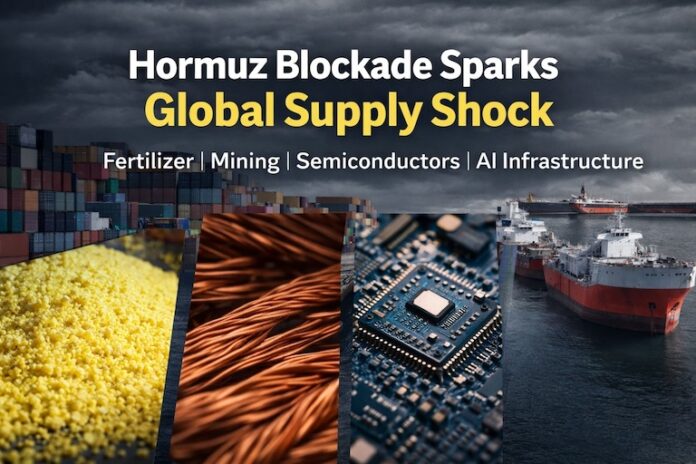
Strait of Hormuz Closure Freezes Global Commodity Arteries
The Strait of Hormuz has become the center of a major trade disruption after Iranian forces attacked commercial vessels following U.S. and Israeli strikes on Iran. Shipping insurers canceled coverage across the corridor, which forced major shipping lines to halt transit through the passage. Tankers and cargo ships now anchor outside the strait as fleets wait for security guarantees that have not appeared. The waterway measures about 21 nautical miles across at its narrowest point, yet it carries roughly 20 percent of global oil shipments under normal conditions. Energy flows draw attention, yet the same corridor carries chemicals and industrial inputs that support agriculture, semiconductor manufacturing, mining, and global manufacturing supply chains.
Fertilizer Supply Shock and the Global Food System
Agricultural markets depend heavily on fertilizer shipments produced across Gulf states and exported through the Strait of Hormuz. Commodity data shows that Gulf producers account for roughly 35 percent to 45 percent of global urea production and about 30 percent of ammonia output. Trade statistics also indicate that about 31 percent of global urea exports normally move through Hormuz shipping routes. Additional fertilizer inputs travel the same path, including 44 percent of sulfur flows and about 15 percent of phosphate trade. These nutrients sustain modern crop yields that feed roughly 50 percent of the global population.
Urea Prices Surge During the Spring Planting Season
The fertilizer market reacted quickly after shipping disruptions trapped cargo vessels outside the Strait of Hormuz. Commodity trading data shows that urea prices have already surged nearly 30 percent during recent weeks. Farmers across the United States now face difficult planting decisions during the spring agricultural cycle. Corn production requires heavy fertilizer applications that exceed the nutrient demands of crops such as soybeans. Higher fertilizer costs push some producers to reduce corn acreage and shift land into lower input crops.
Nitrogen Fertilizer and Global Food Production
Nitrogen fertilizer production depends on ammonia derived from natural gas feedstock produced across the Gulf region. Industrial production converts ammonia into urea and other nitrogen compounds that farmers apply to wheat, corn, rice, and other staple crops. Commodity analysts estimate that about 33 percent of global nitrogen fertilizer feedstock normally passes through the Strait of Hormuz. This fertilizer supports grain harvests that feed billions of people across Asia, Africa, and the Middle East. Interruptions during planting season can reduce crop yields across multiple regions and drive food prices sharply higher.
Sulfur Supply and Industrial Chemical Production
Sulfur supply also connects directly to refining operations located across the Gulf energy sector. Industrial chemical research shows that approximately 92 percent of global sulfur production originates as a byproduct of oil and gas refining. Sulfur serves as the feedstock used to manufacture sulfuric acid, which stands as the most produced industrial chemical on earth. Global sulfuric acid output exceeds 250 million tonnes annually across fertilizer manufacturing and metal processing industries. Disruptions in refinery activity therefore reduce sulfur supply and affect chemical production across multiple sectors.
Sulfuric Acid and Copper Extraction
Sulfuric acid supports several industrial processes that supply metals used across modern infrastructure and energy systems. Mining companies use sulfuric acid to extract copper, cobalt, lithium, and uranium from mineral deposits. Copper mining operations across the Central African Copperbelt rely heavily on sulfur shipments imported from global markets. The region imports about 2 million tonnes of sulfur each year that convert into sulfuric acid used during copper extraction. Industrial conversion ratios show that 1 tonne of sulfur produces about 3 tonnes of sulfuric acid used for metal leaching operations.
Copper Supply Risks from African Mining Regions
Two million tonnes of sulfur shipments generate roughly 6 million tonnes of sulfuric acid used by mining operations across the Copperbelt. Regional smelters also contribute another 2.5 million tonnes of sulfuric acid through copper concentrate processing. Sulfuric acid prices in Kolwezi have already approached $700 to $800 per tonne during recent months across the region. Rising chemical costs increase production expenses for copper and cobalt mining companies operating in the Democratic Republic of Congo. These metals supply electric vehicle batteries, power grid infrastructure, and industrial equipment used across global energy systems.
Helium Supply and Semiconductor Manufacturing
Helium supply chains also face pressure after disruptions halted natural gas operations across Qatar. Industrial gas reports show that Qatar supplies roughly 38 percent of global helium production capacity through facilities linked to LNG processing plants. Semiconductor fabrication plants rely on helium for wafer cooling, leak detection systems, and lithography equipment used during chip manufacturing. Semiconductor-grade helium has no industrial substitute in existing fabrication processes. Production disruptions therefore place immediate pressure on chip manufacturing facilities across the global technology sector.
Taiwan Energy Supply and Chip Manufacturing
Taiwan plays a dominant role in semiconductor production through Taiwan Semiconductor Manufacturing Company. Industry estimates show that TSMC produces about 90 percent of advanced semiconductor chips used across global electronics markets. Taiwan imports large volumes of liquefied natural gas that supply electricity for semiconductor fabrication plants across the island. Shipping data shows that Qatar supplies roughly 30 percent of Taiwan’s LNG imports that normally travel through the Strait of Hormuz. Energy planning estimates show that Taiwan holds about 11 days of LNG reserves under supply disruption scenarios.
Methanol Production and Chemical Manufacturing
Petrochemical plants across Gulf states produce large volumes of methanol used across industrial manufacturing supply chains. Industry capacity data indicates that Gulf producers account for roughly 32 percent to 35 percent of global methanol production. Chemical manufacturers convert methanol into plastics, synthetic fibers, adhesives, and fuel additives used across industrial markets. Methanol also supports biodiesel manufacturing and chemical synthesis used across numerous industries. Export interruptions through the Strait of Hormuz therefore affect chemical manufacturers that consume millions of tonnes of methanol annually.
Plastics Supply Chains and Global Manufacturing
Petrochemical complexes across the Gulf region produce large quantities of polyethylene and polypropylene used across manufacturing sectors. Industry statistics show that Gulf producers account for about 15 percent of global polyethylene capacity. Polypropylene production across the same region represents roughly 9 percent of world manufacturing capacity. Polyethylene supports packaging materials, pipes, plastic containers, and electrical insulation used across construction and consumer markets. Polypropylene supports automobile components, packaging materials, and numerous household products used across global retail markets.
Aluminum Production and Industrial Supply Chains
Aluminum smelters across the Gulf region supply large volumes of metal used across transportation, construction, and energy infrastructure sectors. Production statistics indicate that Gulf producers account for roughly 9 percent of global aluminum output. When Chinese production is excluded, Gulf smelters supply about 22 percent of global aluminum markets. Major exporting countries include Bahrain, Oman, Qatar, Saudi Arabia, and the United Arab Emirates. Aluminum supports aircraft frames, automobile bodies, electrical wiring, renewable energy infrastructure, and large industrial machinery.
One Maritime Corridor Connecting Global Supply Chains
The Strait of Hormuz measures about 21 nautical miles across at its narrowest point, yet the passage connects enormous commodity flows across the global economy. Tankers carrying fertilizer feedstock, petrochemicals, industrial metals, and semiconductor inputs travel through the corridor during normal trade conditions. Commodity statistics show that fertilizer shipments supporting roughly 50 percent of the global food supply depend on flows that move through the region. Semiconductor production relies on helium and energy inputs connected to the same shipping route. The concentration of these supply chains inside one maritime corridor demonstrates how a localized conflict can disrupt agriculture, technology, mining, and global manufacturing simultaneously.
